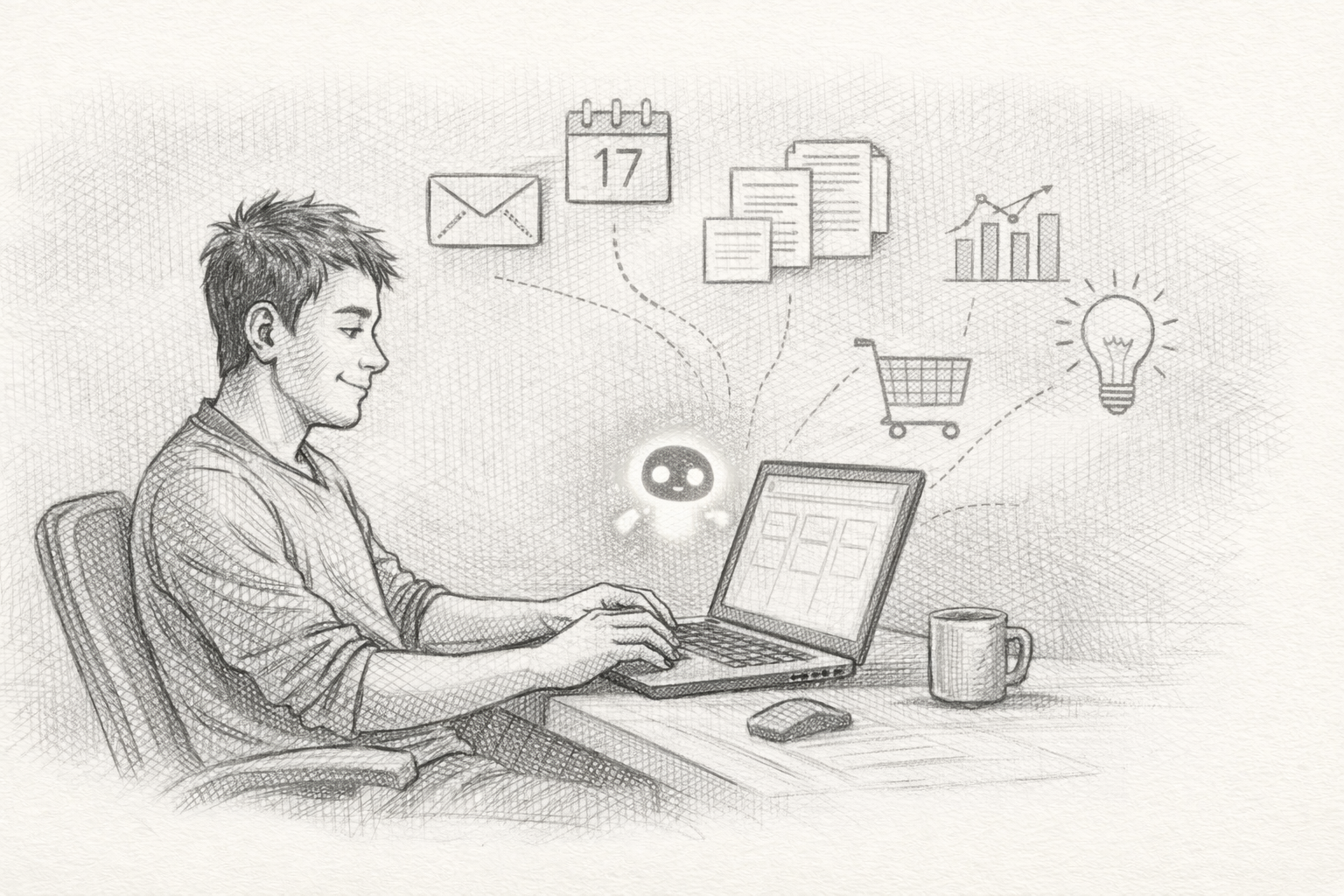
A Framework for Adding Value with AI
The conversation around Artificial Intelligence is often dominated by fears of replacement and obsolescence. This framework reframes that discussion, positioning AI not as a competitor, but as a cognitive partner. It's a tool designed to augment human intellect, foster deeper understanding, and elevate the quality of our work, our learning, and our relationships.
We will explore how to leverage AI to unlock new levels of human capability. The goal isn't to replace human thinking, but to amplify it. It's about transforming AI from a simple answer machine into a collaborative tool that helps us become better thinkers, communicators, and creators.
Navigating New Challenges & Building Competence
This is about using AI as a "scaffolding" tool to build real-world skills. When we face a task we've never done before, the primary barrier isn't just a lack of knowledge; it's the intimidation of the unknown. AI can dismantle that barrier.
For Students & Teachers: A student facing a public speaking assignment is often paralyzed. An AI coach can break it down: "First, let's just brainstorm five main points. Now, let's find one statistic for each point." This process transforms a mountain into a series of small, manageable hills. Similarly, a teacher who needs to learn a new piece of educational software can use an AI tutor that patiently guides them through each function, allowing them to learn at their own pace without the pressure of a live workshop. In both cases, the AI's role is to build the user's competence until they no longer need the guide.
In Business & Personal Life: For an employee taking on a "stretch project," AI can act as an on-demand project manager, helping to outline tasks, identify potential roadblocks, and find resources. This turns a source of anxiety into a structured opportunity for growth. It’s the same principle as tackling a home DIY project. The goal isn't just to replace a sink; it's to overcome the self-limiting belief that "I'm not someone who can do that." By providing a clear, step-by-step guide with troubleshooting tips, AI demystifies the process and builds self-reliance.
Managing Anxiety & Overcoming Fear
Fear is often a reaction to a lack of a plan. AI can help create that initial plan, making the first step less terrifying.
Social & Professional Anxiety: Think of a student wanting to join a new club or an employee starting a new role. The fear is often rooted in the unknown. An AI can serve as a simulator. It can role-play introductions, help draft that first "hello" email, or set small, achievable goals for the first week on the job. Each small, successful interaction builds momentum and provides tangible proof that "I can handle this," directly combating imposter syndrome and social anxiety.
Overwhelming Goals: Starting a business is a classic example of a goal so large it induces paralysis. An AI coach can break the cycle of anxiety by focusing on a "micro-goal." It might say, "Forget the five-year plan. Your only task today is to write one sentence that describes your mission." By making the first step ridiculously small and non-threatening, it helps to manage the fear and start building. This same logic applies to meeting new people at a church or networking event; AI can provide context-specific conversation starters that act as a key to unlock that first interaction.
Interpersonal Dynamics & Communication
AI's greatest strength here is its objectivity. It can act as a neutral third party, helping us see past our own emotional biases.
Understanding Others: When you're in a disagreement, it's nearly impossible to be objective. You can describe the situation to an AI and ask, "What might the other person's perspective be? What are they afraid of? What need am I not hearing?" It removes your own emotional bias from the equation and allows you to see the situation with startling clarity. It can then help you formulate a response that's productive, not destructive.
Improving Your Own Communication: Before sending a difficult email or having a crucial conversation, you can use AI as a sparring partner. It can analyze the tone of your draft and point out phrases that might be perceived as aggressive or passive. It can help you practice articulating your needs clearly and respectfully. This isn't about the AI having the relationship for you; you're using it as a tool to become more skilled and intentional in your relationships.
Cognitive Arbiter & Mediator
The idea of AI as an arbiter isn't about it being a judge that declares a winner and a loser. Instead, its power lies in its complete objectivity. It serves as a neutral, third-party sounding board that can analyze a conflict without the emotional baggage that humans bring to the table. When you're in a disagreement, it can feel like your reality is the only reality. The AI's role is to act as a cognitive mirror, showing you the situation from a detached perspective.
In Personal & Professional Conflicts: You can lay out a workplace dispute or a family argument to the AI. Ask it to "reframe this conversation, assuming both parties have positive intentions" or "identify the core needs each person is trying to express." This simple act can untangle a knot of emotion and miscommunication, allowing you to see the facts of the situation more clearly. It helps you prepare for a productive conversation by separating what happened from the story you told yourself about what happened.
Cognitive Augmentation & Deeper Understanding
This is the core of the "AI as partner" philosophy. The goal is to move beyond simple automation to a state where AI elevates the quality of our thinking.
In Education: The fear that AI will "dumb down" students comes from a view of learning as information recall. But what if we use AI to foster critical thinking? An AI tutor can engage a student in a Socratic dialogue: "You've stated your thesis, but what's the strongest argument against it? What bias might be present in your source material?" This forces the student to engage with the material on a much deeper level, building true comprehension rather than temporary knowledge for a test.
In the Workplace: We can elevate employees from task-doers to strategic thinkers. Let AI handle the mundane first pass—compiling data, generating a basic report draft. This frees up the team's cognitive bandwidth to focus on what humans do best: creativity, critical analysis, and adding that final layer of polish and strategic insight that turns a good report into a game-changing one.
Personalized Learning & Skill Dev.
This is about tailoring the learning experience not just to a student's knowledge level, but to their interests, learning style, and pace. It's the end of the one-size-fits-all model.
For Students: An AI tutor can explain a concept from physics using analogies from video games or sports if that's what interests the student. It provides a judgment-free zone where a student can ask the same "dumb" question ten times until the concept clicks, something they might be too embarrassed to do in front of a teacher or peers.
For Teachers & Organizations: For educators, this means the AI can analyze student work to pinpoint specific conceptual misunderstandings (e.g., this student consistently struggles with fractions, but only when they involve division). For businesses, it means training can be targeted. Instead of a mandatory 4-hour workshop for everyone, AI can create a custom playlist of micro-learning modules for each employee based on their specific skill gaps.
Facilitating Learning Strategies & Metacognition
This moves beyond using AI to learn a subject and into the realm of using AI to improve the process of learning itself. Metacognition, or "thinking about your thinking," is the foundation of effective learning, and AI can act as a coach to implement powerful techniques that are often hard to manage on our own.
Making Proven Techniques Easy: Most of us know we should quiz ourselves (Active Recall) or try to explain a concept in our own words (the Feynman Technique), but we rarely do it systematically. An AI can automate this. After you read a chapter, it can instantly generate a quiz. It can prompt you to explain a concept and then analyze your explanation for gaps in logic. It can also manage a Spaced Repetition schedule, re-introducing topics just before you're likely to forget them. The AI isn't just a source of information; it's a tireless, expert learning partner that ensures you're learning in the most efficient and effective way possible. This transforms learning from a passive activity into an active, engaging process that builds deep, durable knowledge.
Content Creation & Ideation
The "blank page" is often the most intimidating part of any creative or professional task. AI excels at overcoming that initial hurdle, acting as a tireless brainstorming partner.
Co-Creation, Not Automation: The key here is partnership. An employee isn't asking the AI to "write this report." They're asking it to "give me a first draft of a report based on this data, in a professional but approachable tone." This gets them 70% of the way there, allowing them to focus their energy on the most valuable parts: refining the message, adding strategic insights, and ensuring the final product is polished and persuasive. For a student, it can help structure an essay or brainstorm arguments, but the critical thinking and final writing still belong to them.
Analysis & Decision Making
Humans are prone to cognitive biases, especially when making decisions under pressure. AI can act as a data-driven, logical counterweight to our often-flawed intuition.
Enhancing Human Judgment: An AI can analyze a vast dataset and present key trends and correlations that a human might miss. For a business, this provides a robust, factual foundation for making strategic decisions about market entry or product development. For an individual, it can be as simple as analyzing spending habits to reveal unconscious patterns. The AI doesn't make the decision; it provides a clearer, more complete picture of reality, empowering the human to make a more informed and rational choice. It also helps us learn to question our own assumptions by presenting data that may contradict them.
AI Capability | Students | Teachers | Organizations | Employees | Myself (Personal) | Interacting with Others |
Navigating New Challenges & Building Competence | Tackle a daunting assignment (e.g., public speaking) by having AI break it down into manageable steps (research, outline, practice) and simulate the experience for feedback. | Learn a new educational technology tool by having AI provide a step-by-step, interactive tutorial, building confidence before implementing it in the classroom. | Guide a team through adopting a new, complex process (like a new CRM) by providing an AI-powered walkthrough and on-demand Q&A, reducing implementation friction. | Take on a stretch project outside your comfort zone. Use AI to create a project plan, identify necessary skills, and find resources, turning anxiety into a growth opportunity. | Tackle a DIY project (e.g., replacing a sink). AI can provide a step-by-step guide with videos, a list of tools, and troubleshooting advice, demystifying the process. | Prepare for a high-stakes negotiation by having AI help you research, structure your arguments, and anticipate counterpoints, turning an intimidating event into a manageable one. |
Managing Anxiety & Overcoming Fear | Address the fear of joining a new club or speaking up in class. Use AI to role-play introductions and conversations, normalizing the experience and reducing social anxiety. | Overcome the anxiety of parent-teacher conferences by using AI to structure talking points and practice handling difficult questions, leading to more confident and productive meetings. | Address workforce anxiety during times of change (e.g., mergers) by using AI-powered tools to provide clear, consistent information and dispel rumors. | Manage the fear of failure when starting a new role. Use AI to set small, achievable "first week" goals and get positive reinforcement, building momentum and confidence. | Confront the fear of starting a business. Use AI to break the immense goal into small, non-threatening steps like "research one competitor" or "draft a mission statement." | Overcome the fear of meeting new people. Use AI to get conversation starters tailored to a specific event (e.g., a networking event, a new church group) to lower the barrier to entry. |
Interpersonal Dynamics & Communication | Navigate difficult social situations (e.g., disagreements with friends) by using AI to practice and formulate clear, respectful responses, thereby building healthier peer relationships. | Analyze classroom communication patterns. Get AI-driven suggestions for fostering a more inclusive, collaborative, and psychologically safe learning environment for all students. | Use AI tools to analyze team communication for sentiment and clarity, helping leaders identify potential friction points and proactively improve team cohesion and morale. | Draft difficult emails or practice crucial conversations. Use AI to analyze the tone of communication and get suggestions for framing feedback constructively. | Analyze a disagreement to understand another's perspective without emotional bias. Role-play difficult conversations to build empathy and find productive paths forward. | Build stronger relationships by using AI to improve your communication, empathy, and objective understanding of others' perspectives and needs. |
Cognitive Arbiter & Mediator | Analyze group project disputes objectively, identifying communication breakdowns and finding common ground to get the project back on track. | Mediate classroom disagreements by using AI to depersonalize conflict and help students articulate their perspectives respectfully and without accusation. | Serve as a neutral party in departmental disputes, using AI to analyze communications and find points of hidden agreement or misunderstanding. | Get an objective analysis of a workplace conflict, helping to separate facts from feelings before a meeting with HR or a manager. | Use as an unbiased sounding board during a personal conflict, helping to see the situation from a neutral perspective before reacting emotionally. | Act as a mediator in a family dispute, using AI to help all parties feel heard and to map out a mutually agreeable solution without taking sides. |
Cognitive Augmentation & Deeper Understanding | Move beyond rote memorization. Use AI to explore subjects through Socratic questioning, analyze topics from multiple viewpoints, and build genuine, lasting comprehension. | Design lessons that foster critical thinking. Use AI to create complex, scenario-based problems that require deep analysis rather than simple recall, promoting true learning. | Foster a culture of strategic thinking. Use AI to analyze complex problems from multiple angles, moving beyond surface-level data to uncover deeper insights and drive innovation. | Elevate work from simple task-completion to strategic contribution. Use AI to handle mundane data processing, freeing up cognitive bandwidth for creativity and critical analysis. | Challenge personal biases. Use AI as a sparring partner to think through complex decisions, explore different philosophies, and develop more nuanced perspectives. | Understand the cognitive biases that may influence a group discussion or negotiation, allowing you to engage more effectively and persuasively. |
Personalized Learning & Skill Dev. | Use AI tutors not for answers, but to build foundational understanding. Explore subjects in an engaging, personalized way and get help on difficult concepts without fear of judgment. | Create unique lesson plans tailored to individual student learning patterns. Use AI to pinpoint and address specific conceptual misunderstandings for each student. | Identify company-wide skill gaps and deploy targeted, AI-driven training modules to strategically upskill the workforce for future challenges. | Go beyond basic functions to master your tools. Get on-demand assistance with complex software features to improve proficiency and the quality of your work. | Act as a personal coach to set, track, and achieve life goals. Learn new, complex hobbies by having AI break them down into manageable, skill-building steps. | Learn skills like active listening or public speaking by practicing with an AI that can simulate different personalities and provide instant feedback. |
Facilitating Learning Strategies & Metacognition | Move beyond simple studying by using AI to apply learning techniques like Active Recall and the Feynman Technique, ensuring deep, durable knowledge. | Incorporate metacognitive strategies into lesson plans, using AI to generate Spaced Repetition quizzes or Feynman prompts for the entire class. | Design corporate training that sticks. Use AI to create learning modules based on Active Recall and Interleaving to maximize employee knowledge retention. | Learn new, complex skills more efficiently by using an AI coach that employs proven learning strategies, like Spaced Repetition, to accelerate mastery. | Master a new hobby by having an AI structure your learning process using proven techniques, turning passive reading into active, effective learning. | Help someone else learn a new skill more effectively by introducing them to AI-driven tools that facilitate proven learning techniques. |
Content Creation & Ideation | Brainstorm initial ideas for essays and projects. Use AI as a partner to structure arguments and explore creative possibilities, refining the final product with your own critical thinking. | Generate a wide variety of rich, interactive lesson materials. Create diverse examples and analogies that resonate with different learning styles to explain complex topics. | Automate the generation of initial data reports, freeing up teams to focus on strategy and interpretation. Brainstorm innovative solutions to core business challenges. | Co-create high-quality first drafts for emails and reports, allowing you to focus your energy on refinement, strategy, and polish, not the blank page. | Overcome creative blocks for personal projects. Plan events or trips by having AI generate a structured starting point for you to customize and perfect. | Co-author documents or presentations with colleagues by using AI to merge ideas, track changes, and help find a consistent, collaborative voice. |
Analysis & Decision Making | Learn critical thinking by having AI present arguments and data, then challenging you to identify biases, flaws in logic, and underlying assumptions. | Analyze aggregate student performance data to identify curriculum trends, allowing for data-driven improvements to teaching methods and materials. | Use AI to analyze market data, forecast trends, and assess risks, providing a robust analytical foundation for high-stakes strategic decisions. | Analyze your personal productivity data to identify work patterns. Use AI to gain quick, actionable insights from complex data without needing deep technical expertise. | Analyze personal habits (spending, fitness) to make better life choices. Distill complex personal situations into core components for clearer thinking and decision making. | Analyze group decisions or team conflicts by mapping out different stakeholder perspectives and potential resolutions, helping you act as a more effective mediator or participant. |