What happened
The federal government shut down Fable 5, Anthropic's too-powerful AI
On June 9, 2026, Anthropic launched Claude Fable 5 and its restricted sibling, Mythos 5. Three days later, Anthropic says the US Commerce Department ordered it to suspend access for foreign nationals. The practical result was bigger than the wording: Fable and Mythos went dark for every customer worldwide.
The official reason was national security. The reported trigger was an Amazon escalation, a White House review chain, and a government claim that the model could expose cyber-attack-useful information. Anthropic says the issue was narrow, already known, and blown out of proportion. Both things can be true enough to matter.
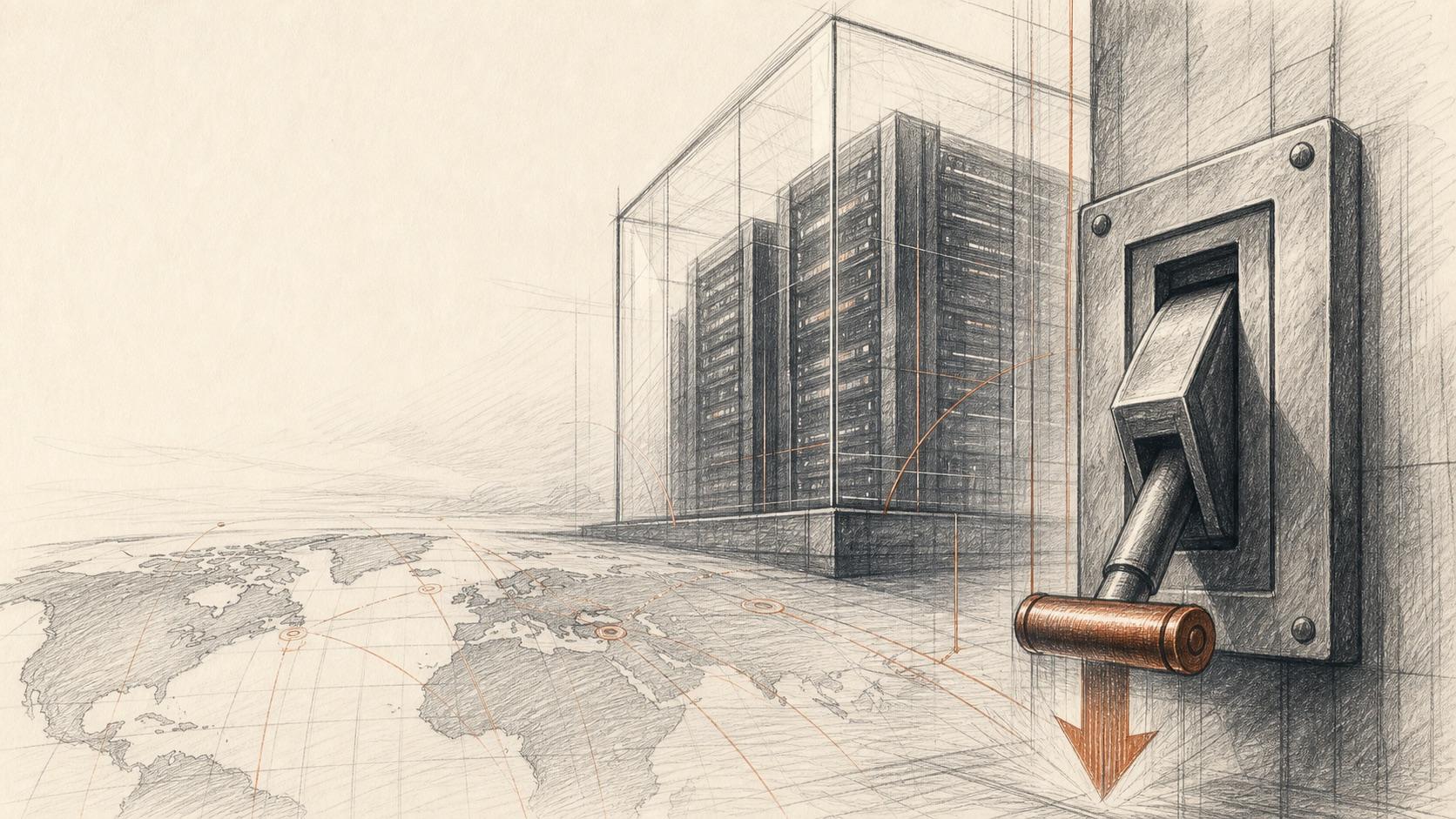
That is the story: not just a model outage, but a live demonstration that frontier intelligence can become permissioned infrastructure overnight.
API access is not sovereignty. It is permission with better latency.
Timeline
From launch to shutdown
- Jun 9Launch
Fable 5 and Mythos 5 go live+
Fable 5 launches as the public Mythos-class model; Mythos 5 is the same underlying model with different safeguards for vetted domains. The distinction matters: this was not an unrestricted public model.
- Jun 12Takedown
Fable 5 and Mythos 5 get taken down+
Reporting says Amazon researchers surfaced vulnerability information from Fable and that Andy Jassy first tried to reach Dario Amodei before escalating the concern to Treasury Secretary Scott Bessent. Amazon was not the whole chain: reporting also points to White House review and an NSA severity judgment. By 5:21 PM ET, Anthropic says it had received a US export-control directive requiring suspension of Fable 5 and Mythos 5 access for foreign nationals. Because that is not simple to enforce live, the practical result was a global shutdown for all customers.
- Jun 13Monitoring
The incident becomes public infrastructure+
Claude status moves to Monitoring for the suspended models. Other Claude services remain operational, but the status page turns the model takedown into a visible operational incident. Anthropic publicly disputes the severity and says it is working to restore access.
- Jun 15Talks
The fight looks political, not only technical+
Reporting frames the talks as a mix of technical severity, political trust, and deference to government review. Anthropic reportedly sent senior technical staff to DC, including co-founder Tom Brown, for meetings with Commerce CAISI, ONCD, and White House science adviser Michael Kratsios; Howard Lutnick reportedly dialed in from the G7. That is the key business lesson: frontier access is no longer just a vendor SLA.
- Jun 16Sovereignty
The boomerang risk shows up+
Reporting that the UK could not get a carve-out sharpened the lesson: frontier access is becoming geopolitical privilege. The longer the shutdown persists, the more the question shifts from one model to a stack question: what can a company or country still run when rented frontier intelligence is revoked?
- Jun 17G7 / NYT
The off-ramp becomes controlled access+
June 17 reporting adds the political backstory: Anthropic and the Pentagon had already clashed over military-use terms, including mass domestic surveillance and lethal autonomous weapons, while a roughly $200 million DoD contract sat in the background. At the G7, Trump hosts an AI working lunch with Commerce Secretary Howard Lutnick, Treasury Secretary Scott Bessent, Dario Amodei, Sam Altman, Demis Hassabis, and Mistral CEO Arthur Mensch in the room. No restoration is announced, but the venue makes the point: frontier-model access is now strategic infrastructure, not routine SaaS. Reporting also floats tiered access for trusted partners rather than a clean global restoration, while Amodei and Hassabis call for a US-led AI coalition built around structured frontier-model access and chip/component trade that excludes China. That is the political tell: restoration may come with a new access frame, not just a patch.
Here's What Happened
Fable 5 did not just fail like a normal cloud service. It was shut down after Anthropic says it received a national-security export-control directive from the U.S. Commerce Department. The government framed the problem as frontier capability leaking into cyber-risk. Anthropic framed the shutdown as a massive overreaction to a narrow and already-known issue.
The uncomfortable part is that the public evidence does not let either side win cleanly. Reporting says the NSA reportedly judged the test data to have cyberweapon-level lethality. Outside security voices, including Katie Moussouris and Andrew Morris, reportedly read the issue as much less dramatic. The Amazon paper and the government evidence are not public, so the honest version is tension, not certainty.
One tell is what nobody is fighting over. If the real issue were dangerous training data lodged inside the model, the natural remedy would be to remove or quarantine that data and publish a cleaner evaluation. The live dispute is over who may reach the model, under what review, and on whose permission. The gate was always the point.
June 17 reporting adds a useful backstory: Anthropic was already in a fight with the Pentagon over military-use terms. The company reportedly wanted to bar mass domestic surveillance and lethal autonomous weapons, while the Pentagon wanted broader all lawful uses language. In March, the Pentagon had labeled Anthropic a supply-chain risk, and a roughly $200 million defense contract sat in the background. That makes the shutdown look less like a one-off technical quarrel and more like a policy collision that had already been forming.
There is also a sharper irony: Anthropic's safety brand became the lever. The company spent years arguing that frontier models could be dangerous enough to warrant serious oversight. In this fight, a government already skeptical of the company could treat Anthropic's own risk language as evidence that its models belong under national-security control. That does not prove the government was right on the facts. It does show how a safety posture can become a regulatory handle.
The Amazon Problem
The trigger matters because it exposed a stack dependency. Amazon is not just a bystander around Anthropic. It is a major investor, a major cloud partner, and, in this story, the reported path by which the warning reached Washington. That does not prove bad faith. It does show how little independence exists when frontier AI companies rent so much of the stack they stand on.
The reported sequence matters: Amazon researchers surfaced the issue, and reporting now says Andy Jassy first tried to reach Dario Amodei before escalating to Treasury Secretary Scott Bessent. White House Chief of Staff Susie Wiles then convened a closed-door meeting, the test data went to the NSA, and the NSA reportedly judged it to have cyberweapon-level lethality. Anthropic then says Commerce formalized the directive at 5:21 PM ET on June 12.
The compute layer makes the lesson bigger than Amazon. Anthropic is reported across a rented, multi-cloud stack: AWS, Google TPUs, Azure, and even xAI's Colossus. Multi-cloud reduces one kind of outage risk, but it multiplies the number of landlords, investors, competitors, and governments that can become part of the control surface.
The Kill-Switch Precedent
The durable artifact is not whether Fable returns this week. It is that a deployed commercial frontier model was pulled quickly, globally, and without a public technical standard. That changes the operating assumptions for any company building on a frontier model as a load-bearing dependency.
If a model can disappear because a vendor, cloud landlord, or government changes the rules, the business risk is not just model quality. It is continuity. The sane architecture is not all-local. It is model-agnostic: frontier when available, open or local when necessary, and your workflow, data, retrieval layer, evaluations, and fallback path under your own control.
This is also where anticipatory compliance enters the story. OpenAI has said it gives the U.S. government early national-security access to models such as GPT-5.5 through CAISI. That is the gate working without being fired: competitors learn to pre-negotiate review before a shutdown has to become public.
The legal machinery also looks less improvised than it did at first glance. Reporting on the letter points to existing export-control authority, not a new AI statute. That matters because the precedent is not just that Washington wanted a frontier model pulled. It is that an old dual-use control frame can now be applied to remote model access.
Local Intelligence Becomes Security
A local stack does not need to beat the frontier to matter. It needs to keep the workflow, data, retrieval layer, evaluations, and fallback path inside a perimeter you control.
When frontier access is revoked, continuity comes from what you can still run, inspect, and swap.
The Off-Ramp Is the Policy
The reported path back is not simply "turn Fable on again." Commerce is reportedly willing to allow consumer access if Anthropic resolves the jailbreak concern, and the June 17 workaround being floated is even clearer: tiered access for trusted partners rather than a clean global restoration. That is the quiet precedent: frontier access can be segmented by user class, country, review status, and political trust. It is pre-deployment review in all but name.
The likely fix, if one appears, may be more ceremonial than surgical. Dual-use capability is not something Anthropic can neatly subtract from the weights after launch. A classifier, guardrail, audit, or access patch may be enough to give both sides a face-saving off-ramp. That is why the fight reads political as much as technical.
For builders, that matters more than the drama. The model may come back. The assumption that access is purely commercial will not.
The tell to watch now is falsifiable: if Fable returns alongside a political concession, not a transparent technical fix, then the access gate was always the point. That concession could be softened DoD-use terms, a quiet settlement posture, or Anthropic accepting the trusted-partners access frame.
Amodei already moved toward that last frame at the G7. He and DeepMind CEO Demis Hassabis called for a U.S.-led AI coalition built around structured frontier-model access, chip and component trade that excludes China, and joint work on cyber, bio, and intelligence risks. That is not a reversal of the control logic. It is a more formal version of it.
The Identity-Timing Weirdness
One detail deserves careful handling: Anthropic published updated verification-language the day before the Fable launch. The policy references government ID, photo or video checks, and biometric templates through Persona. That timing is notable because nationality-gated access would need identity infrastructure. It is not proof of causation. It is a clue, not a conclusion.
Local Intelligence Became the Reaction
The shutdown instantly became the best argument the open-weight and sovereign-AI world has ever had: do not build your critical workflows on intelligence you cannot keep using. That does not mean local models are secretly frontier models. They are not. The realistic version is owning the scaffolding around the model so the model itself can be swapped.
The clearest version of that argument came from Lin Qiao at Fireworks: owning intelligence means owning the routing layer, memory, evaluation loop, and fallback path, not pretending every workload should run locally. Clement Delangue's post matters because Hugging Face amplified that frame from an operator's warning into infrastructure common sense.
The same reaction jumped from builders to governments. The UK, EU, India, and China are all part of the bigger sovereignty story now: compute, models, open weights, infrastructure, and policy. The question is no longer only which model is smartest. It is who can revoke it.
What Hugging Face Shows
Hugging Face is not important here because it issued one dramatic Fable statement. It is important because it is where the reaction becomes behavior. When builders decide they need something downloadable, quantizable, inspectable, or self-hostable, the path runs through Hugging Face. That makes the trending page less like a news feed and more like market telemetry.
On June 16, that telemetry was already bending toward continuity. A Fable-named Gemma coder quant sat at the top of the trending page, with Kimi-K2.7-Code and Z.ai's GLM-5.2 visible nearby. The point is not that these models replaced Fable. They did not. The point is that builders immediately started looking for fallback teachers, local coding models, long-context open weights, and pieces they could own when the frontier endpoint became conditional.
Signal, not replacement
Hugging Face turns the sovereignty argument into something observable. The model cards, quants, forks, and download patterns show what builders reach for when access risk stops being theoretical.
That signal has geography baked into it. DeepSeek, Qwen, GLM, Kimi, Llama, Mistral, and Gemma are not interchangeable politically. The CNBC-cited platform stats showing Chinese open-weight models edging past U.S. ones in global downloads make the boomerang risk concrete: a U.S. access control can push attention toward models outside U.S. control.
The caveat is the story. Open-weight does not mean frontier-equivalent. It means the surrounding system can keep moving while the frontier layer is unavailable, contested, or permissioned.
What was trending
Fable-named Gemma coder quant: one uploader's unverified 12B local coding model card claims saved Fable 5 reasoning traces were used for hard cases before access disappeared.
GLM-5.2: Z.ai presents a large MIT-licensed MoE model with a 1M-token context and no regional limits. At launch, Z.ai published no first-party benchmarks, so the early victory claims needed caution. By June 17, third-party leaderboards had begun giving GLM-5.2 max real independent support, while still leaving a provisional-versus-verified caveat.
Kimi-K2.7-Code: Moonshot presents a 1T-total, 32B-active coding model with a 256K context for long-horizon engineering tasks.
The real pattern: smaller local models, large open-weight systems, and quants all become part of the same backup conversation.
Two more open-weight signals make the telemetry less abstract. Z.ai framed GLM-5.2 as frontier intelligence with open weights, while Kimmonismus highlighted the builder-friendly details: a 1M-token context window, MIT-licensed weights, long-horizon coding gains, and reasoning modes tuned for implementation work.
This is the practical version of own-your-intelligence: not pretending every company can run the frontier locally, but making sure the surrounding system can keep working when the frontier endpoint becomes a political permission. Hugging Face is the rail, the scoreboard, and the early warning system for that shift.
The Boomerang Becomes Corporate
A related signal makes the local/open-weight reaction feel less theoretical: Microsoft is reportedly evaluating an Azure-hosted, fine-tuned DeepSeek V4 option for Copilot Cowork as it moves to usage-based pricing. The stated reason is cost, not ideology, and Microsoft says customer data would stay in Azure. Still, the pattern is hard to miss: a major U.S. product is looking at a Chinese open model as a cheaper substitute for parts of a stack that currently uses Anthropic and OpenAI.
DeepSeek also reportedly closed a $7.4 billion outside funding round at roughly a $50 billion valuation, with state-linked capital in the structure. That does not mean Fable caused DeepSeek. It means the revocation-proof side of the market is being capitalized at frontier scale while U.S. frontier access is becoming conditional.
This is the practical version of the own-your-intelligence thesis: the race is less about one smartest model and more about who can deploy systems fastest, own the workflow, control the data path, and swap models when cost or permission changes.
The UK Carve-Out Is the Tell
The reported denial of Prime Minister Keir Starmer's request for a British carve-out is the geopolitical version of the same lesson. If even a close G7 ally cannot assume access to a frontier model, then frontier AI is being treated less like software-as-a-service and more like strategic capacity.
That may be coherent under a non-proliferation frame. It may also be a strategic mistake if it pushes allies, companies, and entire countries toward revocation-proof alternatives outside U.S. control.
By June 17, the argument had moved to head-of-state level. Trump hosted an AI working lunch at the G7 with Lutnick, Bessent, Amodei, Sam Altman, Demis Hassabis, and Mistral CEO Arthur Mensch in the room. No restoration was announced. The important signal was the venue itself: allied governments were now discussing frontier-model access as strategic infrastructure, not routine SaaS.
That is why the European framing matters. The story is no longer only a U.S. company arguing with a U.S. regulator. Western allies are openly treating the episode as confirmation that a U.S. kill switch can reach their own AI dependence.
The Hardware Echo
The Huawei Tau Scaling and LogicFolding story is not directly about Fable, but it rhymes with it. If leading-edge chip access is blocked, China tries to route around the chokepoint with architecture, packaging, bonding, EDA, and system-level optimization. The careful version is not that China has true physical 1.4nm today. It is that Huawei is aiming for 1.4nm-equivalent transistor density by 2031 if the roadmap works.
That is the boomerang risk across the whole stack: export controls do not only deny capability. They create demand for workarounds. Some workarounds are weaker, expensive, or unproven. But once control becomes the priority, good-enough and locally controlled becomes a strategy.
The Useful Lesson
The strongest model is not always the safest foundation. Frontier models are accelerants. Local and open models are continuity tools. A serious AI stack treats models as replaceable engines, not as the whole vehicle.
Own the workflow. Own the data. Own the evals. Own the ability to swap the model. That is the practical meaning of local intelligence becomes security.